

Georges CLEMENCEAU - Autographed letter signed - First World War



Georges CLEMENCEAU (1841 - 1929), French journalist and statesman
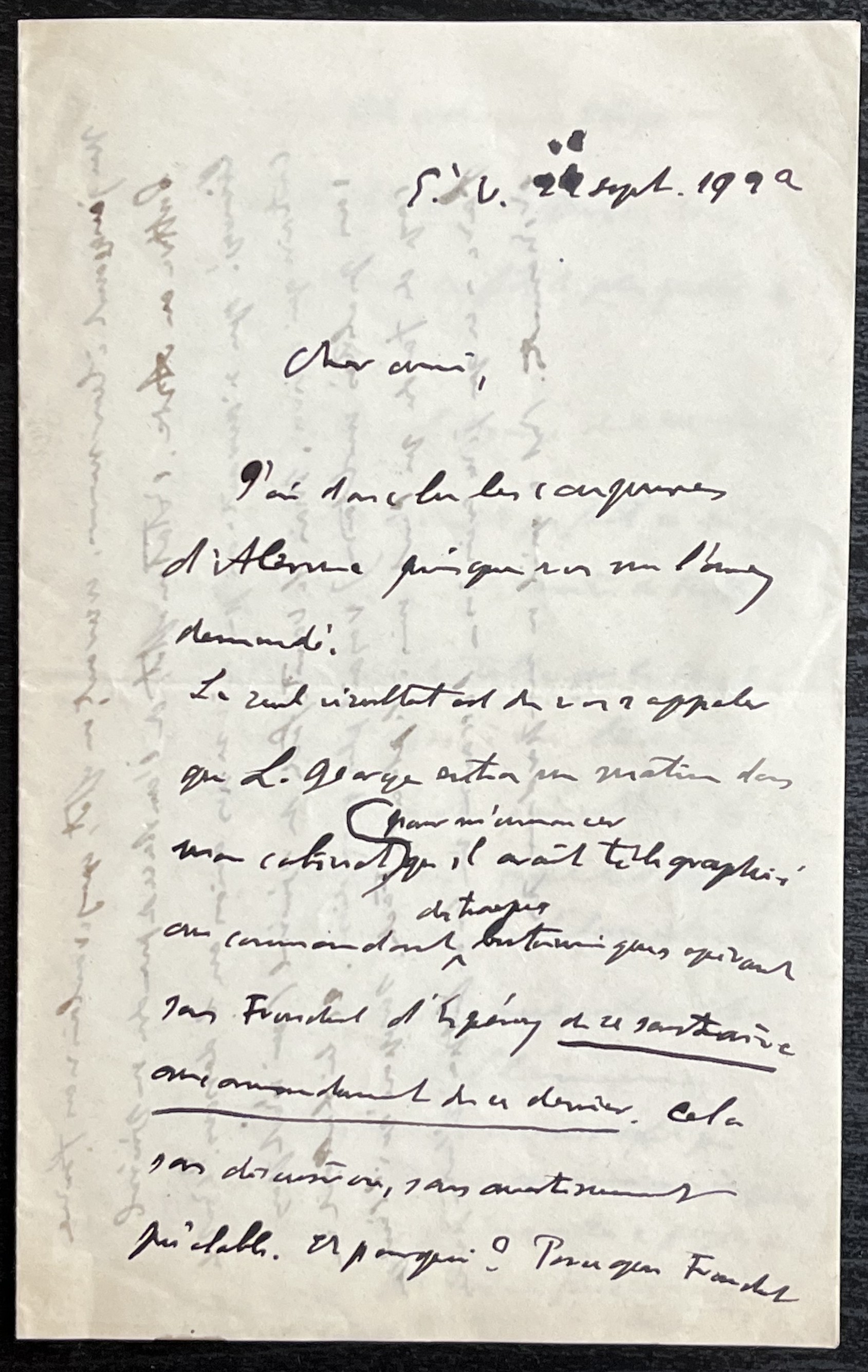
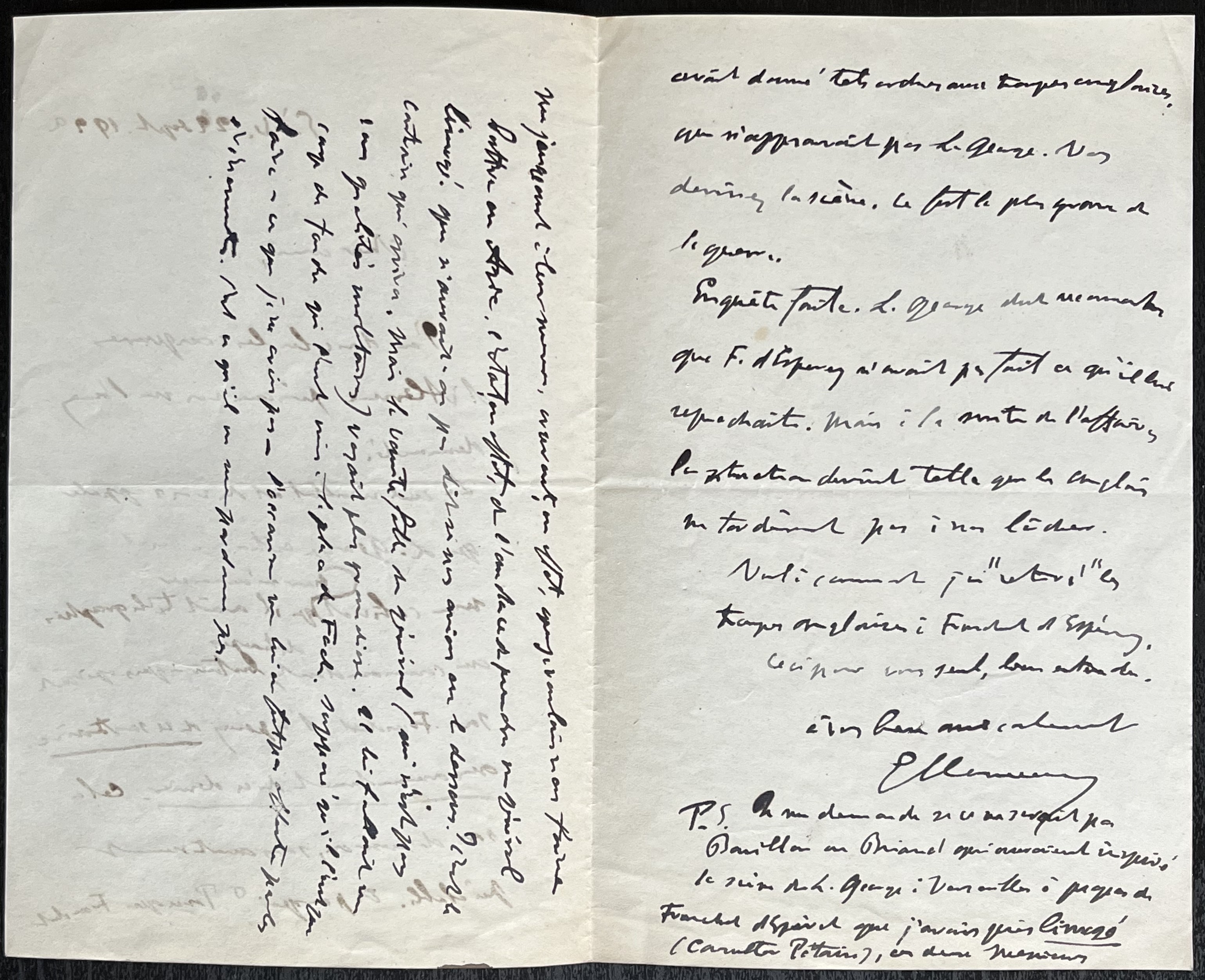
Autograph letter signed to André Tardieu, Commissioner General for Franco-American War Affairs in Washington. St-Vincent sur Jard, September 22, 1922; 3 pages in-8° on a double sheet. Creases from use
The old tiger, in the evening of his life, tells a tasty anecdote spent in his war cabinet with the British Prime Minister Lloyd George, about the withdrawal of English troops under the authority of General Louis Franchet d'Espèrey during the offensive on the Eastern front.
"So I have read the cuttings […] since you asked me to. The only result is to remind you that L. George [David Lloyd George, former British Prime Minister at the end of the First World War] entered my office one morning to announce to me that he had telegraphed the commander of the British troops operating under Franchet d'Esperey to withdraw from the latter's command. This without discussion, without prior warning. And why? Because Franchet had given such orders to the English troops, which L. George did not approve of. You can guess the scene. It was the most serious of the war.
After the investigation, L. George had to admit that F. d'Esperey had not done what he accused him of. But following the affair, the situation became such that the English were quick to abandon us. This is how I "withdrew" the English troops from Franchet d'Esperey. This is for you alone, of course (...). PS I wonder if it was not Bouillon or Briand who inspired the scene of L. Georges at Versailles about Franchet d'Esperey whom I later dismissed (Pétain notebooks), these two gentlemen, sizing me up by their own measure, admitted to me, in fact, that I wanted us to be beaten in Asia. It was, in fact, audacious to take on a dismissed general. What would not have been said if we had been defeated? The opposite happened. But the general's fatal vanity (who is not without military qualities) saw more grandiose things. He needed a thunderbolt that would have put him in Foch's place. Supposing he could have done it - which I do not believe - the opportunity was not offered to him by events. That is what he did not forgive me for.
In this remarkable letter, Clemenceau refers to the expedition of the Allied armies to Salonika led by General Louis Franchet d'Espèrey. This vast army included 157,000 Greeks, 119,000 Serbians, 43,000 Italians and 138,000 British. He achieved victory over the German and Bulgarian troops after fourteen days despite the difficulties encountered in the face of the Allies' demands. The armistice was signed on September 29, 1918, ending the Eastern Front.
Autograph letter signed to André Tardieu, Commissioner General for Franco-American War Affairs in Washington. St-Vincent sur Jard, September 22, 1922; 3 pages in-8° on a double sheet. Creases from use
The old tiger, in the evening of his life, tells a tasty anecdote spent in his war cabinet with the British Prime Minister Lloyd George, about the withdrawal of English troops under the authority of General Louis Franchet d'Espèrey during the offensive on the Eastern front.
"So I have read the cuttings […] since you asked me to. The only result is to remind you that L. George [David Lloyd George, former British Prime Minister at the end of the First World War] entered my office one morning to announce to me that he had telegraphed the commander of the British troops operating under Franchet d'Esperey to withdraw from the latter's command. This without discussion, without prior warning. And why? Because Franchet had given such orders to the English troops, which L. George did not approve of. You can guess the scene. It was the most serious of the war.
After the investigation, L. George had to admit that F. d'Esperey had not done what he accused him of. But following the affair, the situation became such that the English were quick to abandon us. This is how I "withdrew" the English troops from Franchet d'Esperey. This is for you alone, of course (...). PS I wonder if it was not Bouillon or Briand who inspired the scene of L. Georges at Versailles about Franchet d'Esperey whom I later dismissed (Pétain notebooks), these two gentlemen, sizing me up by their own measure, admitted to me, in fact, that I wanted us to be beaten in Asia. It was, in fact, audacious to take on a dismissed general. What would not have been said if we had been defeated? The opposite happened. But the general's fatal vanity (who is not without military qualities) saw more grandiose things. He needed a thunderbolt that would have put him in Foch's place. Supposing he could have done it - which I do not believe - the opportunity was not offered to him by events. That is what he did not forgive me for.
In this remarkable letter, Clemenceau refers to the expedition of the Allied armies to Salonika led by General Louis Franchet d'Espèrey. This vast army included 157,000 Greeks, 119,000 Serbians, 43,000 Italians and 138,000 British. He achieved victory over the German and Bulgarian troops after fourteen days despite the difficulties encountered in the face of the Allies' demands. The armistice was signed on September 29, 1918, ending the Eastern Front.
This description has been translated automatically. please click here Click here to display the original language FR
This item is sold by a professional art dealer who guaranties its authenticity. This item is used (second-hand)
For sale
Price :
1300 € Incl. VAT
Premium and Taxes included
Delivery France:
22.10 € incl. VAT (*)
Country prices, click on See
See more
Hotline
Please contact us for any question regarding this object. For any other inquiry, we invite you to fill the contact form.
Other items from the category « lettre »
