

Raoul DUFY (after) - Les blés, 1933 - Lithograph


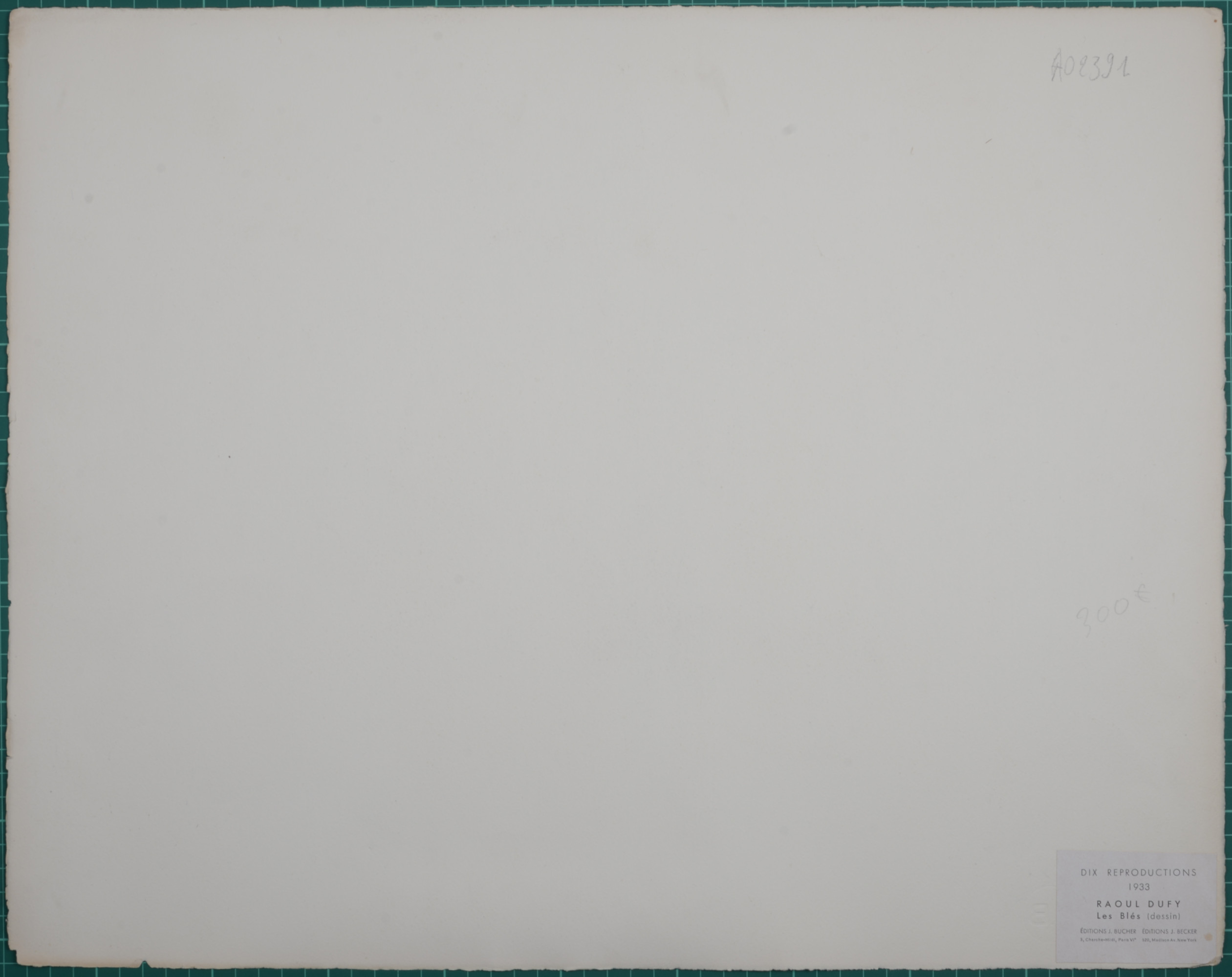

Les blés, 1933
Lithograph on Vélin d'Arches paper, after 1932 Raoul Dufy's ink drawing.
Edition of 1 000.
Jeanne Bucher's blind stamp bottom left.
J.B's watermark upper right margin & Arches' watermark lower right margin.
Dimensions:
+ Size of the sheet: 40 x 52 cm / 15,7 x 20,4 in.
+ Size of the image: 38 x 51 cm / 14,9 x 20 in.
Condition: In fair/good condition, with soft handling creases at the edges. Some small tears and some discoloration in the margins (especially the right one), with one tiny missing part on the top
left corner. Image very clean otherwise.
Issued from the famous "Dix Reproductions 1933" in-folio.
Reproduced by Maison Faucheux.
Printed in France.
Edited by Editions Jeanne Bucher, Paris & John Becker, New York.
Dimensions :
- Height : 40 cm
- Width : 52 cm
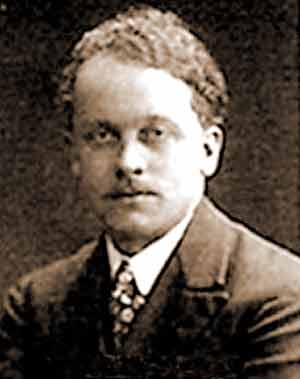 Raoul Dufy :
Brother of artist Jean Dufy, Raoul was born in 1877 in Le Havre where he spent his childhood. Fine Arts school student, he works in Paris since 1900, showing art fisrt an interest in impressionist and postimpressionist artists. Dufy works with Albert Marquet at Fécamp, Trouville and Le Havre. 1905 marks for him an evolution toward a new painting. The discovery of Matisse's "Luxe, calme et volupté" (1904) is at that time a revelation of his rupture from impressionism ("Jeanne in the flowers", 1907). Around 1909, his work becomes lighter, adding grace and humor ("The bois de Boulogne", 1909). The artist also reveales himself in the illustration of litterary works as "Bestiaire d'Orphée" by Apollinaire in 1910. He also shows interest in decorative art and creates a textile decoration compagny with Paul Poiret in 1911. After the second World War, his painting reachs his final style, characterized by a sharp drawing, pure colors with arbitrary contour, generally representing a crowd on tint areas of bright colors ("Race in Epson", 1935). After the war the artist pratice more and more watercolor and the end of his life leads his work toward a greatest starkness ("The red violin", 1948). In 1952, Dufy won The International Grand Prize of Painting at the XXVIth Venice Biennale, he died the following year.
Raoul Dufy :
Brother of artist Jean Dufy, Raoul was born in 1877 in Le Havre where he spent his childhood. Fine Arts school student, he works in Paris since 1900, showing art fisrt an interest in impressionist and postimpressionist artists. Dufy works with Albert Marquet at Fécamp, Trouville and Le Havre. 1905 marks for him an evolution toward a new painting. The discovery of Matisse's "Luxe, calme et volupté" (1904) is at that time a revelation of his rupture from impressionism ("Jeanne in the flowers", 1907). Around 1909, his work becomes lighter, adding grace and humor ("The bois de Boulogne", 1909). The artist also reveales himself in the illustration of litterary works as "Bestiaire d'Orphée" by Apollinaire in 1910. He also shows interest in decorative art and creates a textile decoration compagny with Paul Poiret in 1911. After the second World War, his painting reachs his final style, characterized by a sharp drawing, pure colors with arbitrary contour, generally representing a crowd on tint areas of bright colors ("Race in Epson", 1935). After the war the artist pratice more and more watercolor and the end of his life leads his work toward a greatest starkness ("The red violin", 1948). In 1952, Dufy won The International Grand Prize of Painting at the XXVIth Venice Biennale, he died the following year.
This item is not available. Please click on « View the catalog » to see similar items available.
